How to Mix Metals in a Luxury Home
Mixed metals were once something designers cautioned against. Stick to one finish, the rule went, and the room will hold together. That thinking has largely been retired – not because consistency stopped mattering, but because the conversation got more nuanced.
The interiors getting the most attention in 2026 are not monolithic. They layer finishes the way a well-dressed room layers textiles – with intention, hierarchy, and an understanding of which elements are doing the heavy lifting and which are playing a supporting role. Done well, mixed metals add depth that a single finish rarely achieves on its own. Done carelessly, they just look unresolved.
The difference is structure, and this guide covers how to build it.
Key Takeaways
• Mixed metals work when there is a clear hierarchy – one dominant finish, one supporting accent.
• Each finish should appear at least twice in the space to read as intentional rather than accidental.
• Warm metals pair more easily with each other than warm and cool metals do – but both can work with the right approach.
• Kitchen and bathroom hardware should be coordinated, not necessarily matched.
• The finish on plumbing fixtures typically sets the dominant tone – hardware follows from there.

© Jean-Louis Deniot
Start with a Dominant Finish
Before introducing a second metal, establish the first one clearly. In a kitchen, that usually means the plumbing fixtures – faucet, pot filler, range hood details – since these tend to be the largest and most visually anchored metal elements in the space. In a bathroom, it's typically the faucet and shower trim.
Whatever finish anchors those fixtures becomes the room's primary metal. Cabinet hardware, towel bars, hooks, and accessories can then either match it or introduce a deliberate contrast – but the primary finish needs to be settled before that decision makes any sense.
If you choose the accent finish first and work backward, the room tends to feel pulled in two directions without a clear center. Start with the dominant and build from there.
The Two-Finish Rule
Most spaces read best with two metal finishes, not three. Two is enough to create depth and visual interest. Three starts to require a level of coordination that is difficult to sustain across an entire room – and in smaller bathrooms especially, it rarely lands well.
The cleaner approach: one finish for plumbing and one for hardware. Or one for primary cabinetry and one for accent pieces. The specific assignment matters less than its clarity.
Where designers occasionally introduce a third finish successfully is in larger, more complex spaces – a kitchen with an island that reads almost as a separate zone, for example, or an open-plan living area where the hardware transitions between distinct functional areas. In those cases, the third metal tends to be confined to a single zone rather than being scattered throughout the space.

© amuneal
Pairing Warm Metals with Each Other
Warm metals – brass, bronze, gold tones, unlacquered and aged finishes – are the most forgiving to mix because they share an underlying tonal language. The differences between them read as variation rather than conflict.
Brass and bronze
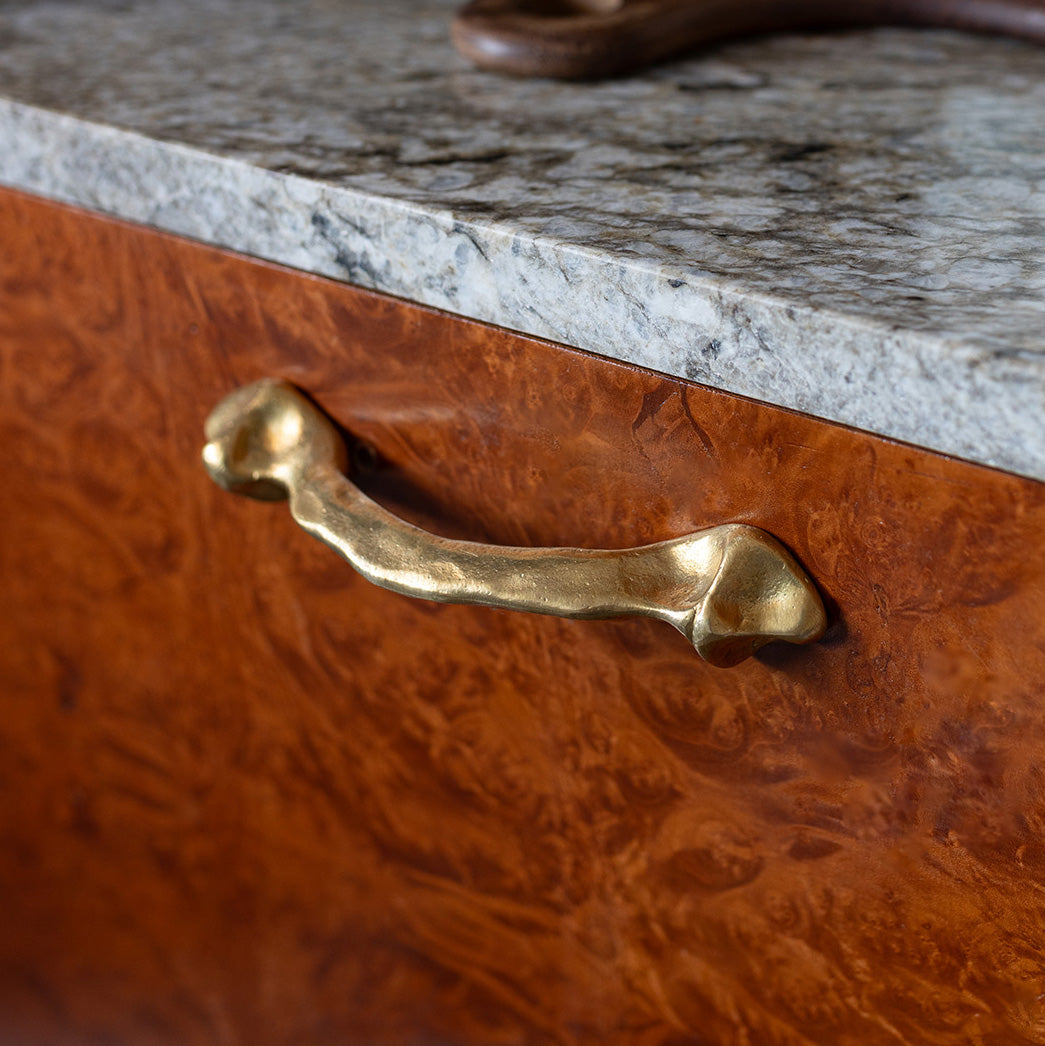
This is one of the more natural pairings available right now. Brushed or satin brass for cabinet hardware alongside dark bronze plumbing fixtures – or the reverse – creates a layered warmth that feels collected rather than matched. The key is keeping the two finishes in different categories: one on the cabinetry, one on the plumbing, so they each have a clear domain.
Unlacquered brass and aged bronze
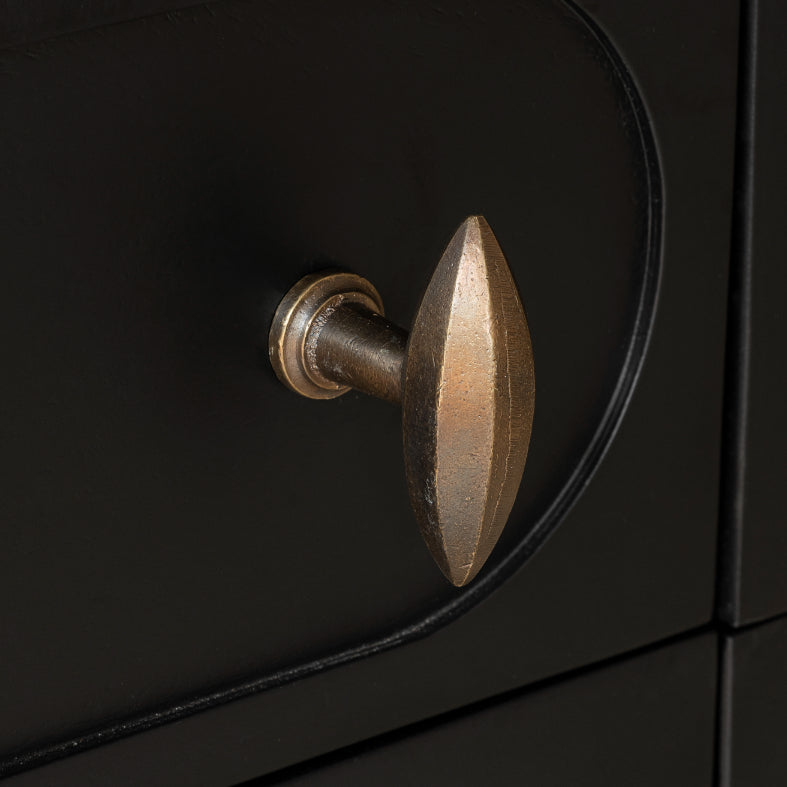
Both are living finishes that will shift over time, which means the relationship between them will evolve rather than stay fixed. They tend to move in compatible directions – the brass warming and deepening, the bronze darkening – so the pairing often improves with age rather than diverging.
Brushed brass and matte gold
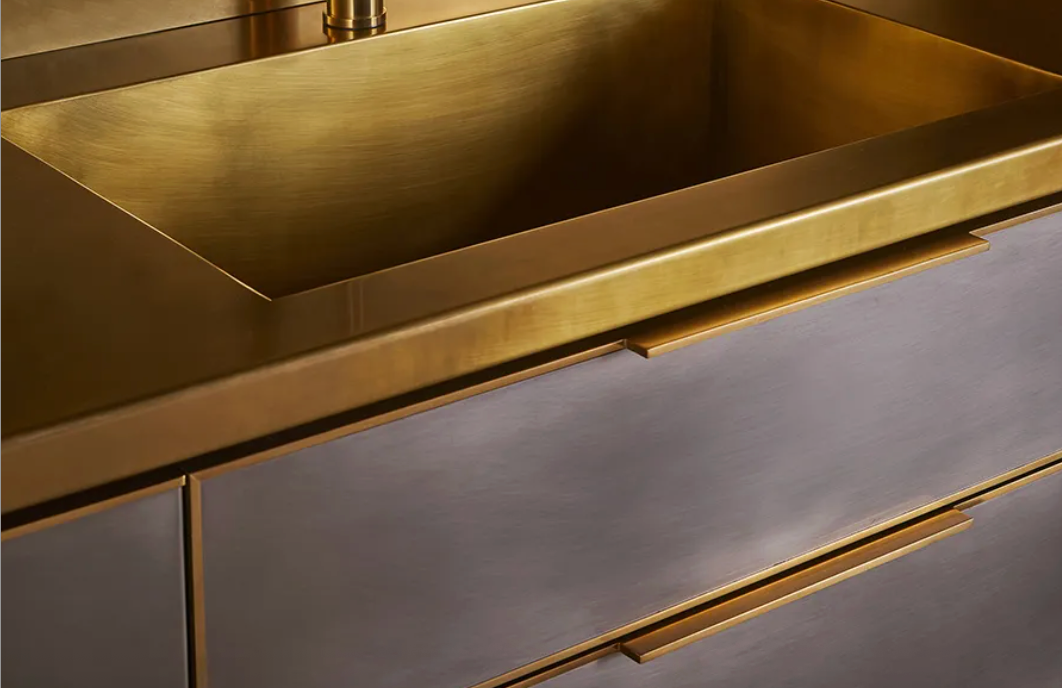
These sit close enough in tone that the difference is subtle – more about texture than color. Using them together works best when the distinction is visible up close, but the overall warmth reads as unified from across the room.
Pairing Warm and Cool Metals
Warm and cool metals require more care but produce some of the most interesting results when the contrast is handled deliberately.
Brass and polished nickel
A classic pairing for good reason. Polished nickel has enough warmth in its tone to sit comfortably alongside brass without the stark contrast feeling. The combination works particularly well in bathrooms – brass cabinet hardware with nickel faucets has appeared consistently across high-end residential projects for years and shows no signs of feeling dated.
Bronze and satin nickel
The muted quality of satin nickel means it doesn't fight the depth of a bronze finish. Assigning satin nickel to plumbing and bronze to accessories – or vice versa – keeps the contrast controlled. The room feels layered rather than split.
Matte black and brass
This combination has been well-documented and still works – particularly in kitchens where the black anchors the fixtures and the brass warms the cabinetry. The risk is that it has become common enough to feel like a default. Using it with intentionality – brass in a less expected finish, like unlacquered or aged, for instance – keeps it from reading as a stock choice.
Looking for cabinet hardware that holds its own alongside a second finish? Explore the cabinet pulls and knobs collection.
Coordinating Across Kitchen and Bathroom
Mixed metals become more complex when the question extends beyond a single room. In open-plan homes, especially, the relationship between the kitchen and adjoining spaces is hard to ignore.
The finishes don't need to match across rooms – and in most cases, they shouldn't. What they should do is relate. A kitchen in brushed brass and a bathroom in polished nickel can coexist easily because both tones are warm or neutral. A kitchen in matte black and a bathroom in antique bronze require a bit more thought – but the shared warmth of the bronze against the black's depth gives them a thread.
The simplest rule: avoid abrupt temperature changes between adjacent spaces. Cool-to-warm transitions are more difficult to navigate than warm-to-warm or warm-to-neutral ones.
What Tends to Go Wrong
Most mixed-metal schemes that don't work share a few common patterns:
• No hierarchy – two finishes used in roughly equal measure across the same elements, so neither reads as dominant. The room feels indecisive rather than layered.
• Accidental repetition – a finish that appears once in an isolated location, like a single light fixture, that wasn't part of the metal scheme. It reads as an oversight rather than a choice.
• Temperature clash – a warm metal and a cool metal used in close proximity without enough contrast to make the juxtaposition feel intentional. The difference is noticeable but the logic isn't clear.
• Too many finishes in a small space – a powder room or small bathroom with three different metals almost always reads as unresolved, regardless of how considered each individual choice was.
Want to talk through a hardware finish scheme for a specific project? Explore the bathroom accessories collection and cabinet hardware, or reach out to our team to discuss your specifications.
 ©YSG Studio
The Right Mixture for Your Space
Mixing metals is not a rule to follow or avoid. It's a tool that, when used with some structure behind it, produces interiors that feel more considered than those built around a single finish throughout. The homes that do it well are not the ones with the most interesting combinations. They're the ones where the logic is clear enough that you don't notice the mixing at all – you just notice that the space feels right.
Working on a project that calls for hardware with genuine material depth? Explore Mi & Gei's cabinet hardware collections and bathroom accessories, or reach out to our team to talk through your specifications.